Wednesday, June 5, 2013

1910 - THE LAST YEAR OF GIBSON GIRL POPULARITY

Typical Gibson Girl outfit
The "horrible" hobble skirt
If you are following this blog or have read Rosetta's memoir written at age 80, CAN WE COME IN AND LAUGH, TOO? you know we're now following milestones during the years of her life. If you don't have a copy of this endearing book, it is available in Kindle and paperback editions.

On November 18, 1910, Rosetta was one-year-old .
The Gibson Girl was in the last year of its popularity because women had begun to turn their thoughts toward more comfort in 1910, but many made a bad choice when they quickly fell for the hobble skirt.  Imagine trying to walk with speed and balance practically bound at the knees.

Fabrics became lighter, colors brighter, and styles looser. Shockingly, lowered necklines became popular, spurring sales of cold cream and lemon extract.

1910-Rosetta's sister Jean and her husband
Many other fashion trends were introduced that year, like the sack, the sheath, oriental costumes, harem trousers, and the Hellenic tunic. Head gear and furs were also popular. Rosetta's sister Jean was about 19 then and probably would have loved to indulge herself with trendy clothing, but they were a poor family and every penny counted.


During the 1910s, Rosetta's older brothers would have worn tweed jackets and striped blazers. The wealthier business men wore striped trousers, a morning coat and starched white shirt. Some wore top hats and frock coats.

So how about little Rosetta? Well, although the most radical changes were in women's wear, from 1910 to 1919 kids' fashion was characterized by more clothing designed specifically for children than ever seen in history. Take the sailor suit for boys for instance. By 1910, the sailor suits we see in old movies were predominantly worn by younger boys as their main outfit. They might even have had a fancier sailor suit for special occasions, but believe it or not, this was what many wore until adolescence.

Imagine how someone of that era would have reacted to seeing the teens of today. 

Thursday, May 9, 2013

INDY 500 BEGAN THE YEAR ROSETTA WAS BORN -- 1909


Historical Milestones During Rosetta's Early Years

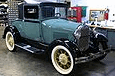
A 1909 RACECAR
Rosetta was born in Chicago, Illinois on November 18, 1909. Just three months before she entered this world, the first race was held at the Indianapolis Motor Speedway, now the home of the world's most famous motor racing competition, the Indianapolis 500.


It was built on 328 acres of farmland five miles northwest of Indianapolis, Indiana by local businessmen as a testing facility for Indiana's growing automobile industry. The idea was that occasional races at the track would pit cars from different manufacturers against each other. After seeing what these cars could do, spectators would presumably head down to the showroom of their choice to get a closer look.

You have to remember that cars were not very prevalent at that time, so this was an innovative venture to promote those newfangled motor cars. The rectangular two-and-a-half-mile track linked four turns, each exactly 440 yards from start to finish, by two long and two short straight sections. In that first five-mile race on August 19, 1909, 12,000 spectators watched Austrian engineer Louis Schwitzer win with an average speed of 57.4 miles per hour. For the day, that was real speed. The track's surface of crushed rock and tar proved a disaster because it broke up in a number of places and caused the deaths of two drivers, two mechanics and two spectators.

The surface was soon replaced with 3.2 million paving bricks, laid in a bed of sand and fixed with mortar. Dubbed "The Brickyard," the speedway reopened in December 1909, just after Rosetta was born. Her parents were too poor to even think of owning a motorcar and wondered if this fad would catch on.

 In 1911, because of  low attendance the track's owners made a crucial decision: Instead of shorter races, they resolved to focus on a single, longer event each year, for a much larger prize. That May 30 marked the debut of the Indy 500--a grueling 500-mile race that was an immediate hit with audiences and drew press attention from all over the country. Driver Ray Haroun won the purse of $14,250, with an average speed of 74.59 mph and a total time of 6 hours and 42 minutes. In those days, that was a fortune.

Rosetta, like many women of her era, never learned to drive. The thought of women racecar drivers was thought to be as ridiculous as putting a man on the moon. Well, both happened.

In her book, "Can We Come In and Laugh, Too?" Rosetta spins tales of what it was like growing up as the youngest of ten children in a zany family and the former Charleston Champ takes you through the Jazz Era, World War II and more.  Paperback and Kindle


Saturday, March 16, 2013

ROSETTA IN THE 1920s


Rosetta and her sister shared a wardrobe in the late 1920s

My sister Edna was an excellent secretary and when she left a job she always wound up with a better one. Edna and I worked just a couple of blocks away from each other in the downtown section of Chicago. The work week was five and a half days and when we were finished on Saturday afternoon, we met at a cafeteria across the street from Swartchild. We had some lunch and then went shopping in the department stores.

1920s PAJAMA PARTY - ROSETTA AND HER 
CO-WORKERS FROM SWARTCHILD & COMPANY

Rosetta is in the third row in the middle. If some of the women look "stoned" it is

 because in those days if anyone's eyes were closed, the photographer painted in the eyes--
not always with a great result!

With meager earnings, we couldn’t afford much of a wardrobe singularly, so we decided to buy our dresses together. Edna was five feet tall, and I am five foot-two. Edna was heavier than me, so what she took up in width I took up in height. 

She tried a dress on first and if it looked good on her, then I tried on the same dress. If it looked good on both of us, we split the cost. I earned all of eighteen dollars a week, and Edna earned more. I don't know how much more, but both of us contributed half of our pay to the household.

We couldn't go on wild shopping sprees, but little by little we managed to increase our wardrobe. We checked with each other in the evenings, figured out which dress each of us wanted to wear to work the next day, and that way there wasn’t any squabbling in the morning.

When Saturday evening came, we got together with our girlfriends and went dancing. We always went in a group. Since we all lived in the same area, it was safer that way. There were dances every weekend in the better hotels and the big bands sure played up a storm. We had lots of good times in those days. I guess we were pretty innocent, but we lived for those weekend dances. I became a champion Charleston dancer.

Tuesday, March 12, 2013

Pictures from the Past

Morgan and Rosetta
This photo was taken many years ago in Chicago when Rosetta was a new mother. And that kid in her arms--well, that's me.

Morgan and Phyllice
It's funny but at one time she told me I was born a bit late in her life because she had a stillborn little girl at least five years before I made my debut. The doctors said she wouldn't be able to have more children, but lo and behold, I guess I just wouldn't take no for an answer. Not only that, but I was followed by my sister Phyllice.

This is one of those stories that isn't in her book. Apparently I was supposed to be born in Detroit, but that was where that first child died. The baby was full term, but her  umbilical cord was wrapped around her neck and they didn't discover it soon enough. Somewhere near the end of her term with me she panicked, worried that something would be wrong with me, too, and fled back to Chicago. I was born at 5 minutes after midnight and the hospital certificate says August 25 but my official birth certificate says August 26. The funny part of it is as dementia took hold when Rosetta was in her 90s and I asked about that first baby, she had no recollection of ever having any children besides my sister and me. I guess the mind has a way of wiping out unpleasant things as it moves toward 100. She made it until nearly 97.

If you didn't get a copy of her funny and sometimes heart-tugging memoir, CAN WE COME IN AND LAUGH, TOO?  the Kindle edition will be FREE at Amazon on March 14-15 and 16. Tell your friends, too, and remember a book makes a great gift. Think about Mother's Day which is not too far in the future, now.

MORGAN ST. JAMES
Rosetta's Daughter

Monday, March 4, 2013

Rosetta's family loved dressing in costumes

Rosetta's sister-in-law Lillian and best friend Rose in the early 1950's.
For as long as I can remember, Halloween was always a special time for Rosetta and her friends and relatives. It was a chance to dress up in outrageous costumes and play tricks on each other.

During my childhood and teen years, my family's love dressing for in costumes was shared by aunts, uncles, cousins and friends--they all jumped at the chance. Combined with my father's love of putting costumes together with whatever was at hand, it must have passed through the generations. My three children Scott, Jakki and Jason and my sister Phyllice's son Ross all inherited the talent and urge to dress in costumes. One of my sister's favorite photos taken during the time she lived in Alaska is of her dressed as the Good Witch of the North in a lovely dress and garland wreath with hiking boots sprayed with gold paint. Yes, it was for Halloween, not a casual, around-the-house outfit.

Phyllice as the Good Witch of the North
Rosetta joined right in and although she usually put something together that was guaranteed to produce laughter, she wasn't always delighted with the costumes my father created. Like the time he decided to dress up as Baby New Years for a party at our apartment. Everyone had to stifle giggles when this overweight man with a black "5 o'clock shadow" pranced into the room dressed in a strategically arranged bed sheet, sporting a banner from shoulder to waist proclaiming that he was the new baby for 1951. Belly bouncing, he gaily went from one guest to another touching them with a makeshift wand and wishing them a wonderful new year.

Yes, Rosetta had helped with his getup and managed not to "spill the beans" to the guests so his appearance could have full impact, but as a twelve-year-old hiding in the shadows I could tell she wasn't all that pleased. That was a lot of exposed skin for 1951! She never said a word, though. She supported my father in whatever he chose to do and when it involved laughter it was all the better.

Rosetta's book, Can We Come In and Laugh, Too?,  has delighted thousands with the stories about her zany family's antics dating back as far to her childhood in the early 1900s. It is available in paperback at multiple online booksellers for $9.99 and the Kindle edition is just $2.99 on Amazon.

"This book is  funny, sincere and delightful."  Logan's Library

Keep watching the blog for more stories.

MORGAN ST. JAMES
Rosetta's daughter

Thursday, November 29, 2012

DO YOU KNOW THE ORIGIN OF "WHEN IT RAINS, IT POURS"?

 Looking back at things that occurred during Rosetta's early years
1911 - ROSETTA WAS TWO WHEN MORTON SALT BECAME AN INNOVATOR

So many things that we take for granted these days happened at the beginning of the 1900s when Rosetta was a young girl. We will be taking these trips down memory lane with her on this blog.

 Most of us know the expression, "When it rains, it pours," but did you ever wonder how it originated? Let's go back to the year 1911, the year Rosetta was only two years old.
Morton Salt Girl - 1914

In 1889 Joy Morton acquired the Onondaga Salt Company and renamed it Joy Morton & Company. In 1910 they changed the name to the Morton Salt Company.

In those days, when the weather was humid salt would cake and be hard to pour. However, by 1911 the newly named Morton Salt Company came up with a major advance—the addition of an additive that prevented caking, made their product free-flowing in any weather, and therefore highly competitive. 

They needed an advertising campaign to get this news out to the public and hired the advertising agency N.W. Ayer & Company. 

Their quest was to come up with a campaign that would put Morton Salt in every cupboard. It took twelve proposed ads and three substitute options, but they finally had it.

Morton Salt Girl Now
Joy Morton's son Sterling, decided upon an image of a young girl. Her umbrella was carefully held in one hand, but the blue package of salt was not so carefully held. Despite the rain, salt poured from the package in the soon-to-become iconic image. The picture told the story: Morton Salt was clump-free, regardless of the weather or storage conditions.

The slogan "When It Rains It Pours®", adapted from an old slogan "it never rains, but it pours," and the Morton Salt Umbrella Girl made its official debut on the blue package of table salt in 1914. Of course, a girl must keep up with the fashions and the image changed many times through the years, but the slogan is still used in general conversation today.

Rosetta's memoir, "CAN WE COME IN AND LAUGH, TOO" makes a wonderful gift during the holiday season.


Monday, September 10, 2012

The family loved going to Rosetta's brother's Camp Ojibwa in Eagle River, Wisconsin

Camp Ojibwa  Meyer, his wife Bea, Al, Sam, Matilda, Jean and  Edna
One of the big delights for the family was an excursion to her brother Al's Camp Ojibwa in Eagle River, Wisconsin.

It is amazing how well-known it became and how many celebrities acknowledged it. Even the Alan Sherman song, "Camp Granada" was inspired by Al's camp. You see, Sherman was one of his counselors, but how do you rhyme with Ojibwa?

At one time baseball's famous Leo Durocher left a game to spend two days at the camp, but the Chicago Tribune found out and did a cartoon with him wearing a Camp Ojibwa tee-shirt.
Here is a post about it from www.funtrivia.com

14. An incident occurred in late July (Saturday, July 26) involving Leo Durocher. Do you remember what he did?

     Leo called Jack Brickhouse a mental midget on the "Tenth Inning" show
     Leo left a game and went up to Camp Ojibwa
     Leo punched home plate umpire Harry Wendelstedt while arguing balls and strikes
     Leo won his 1000th career game as a manager


Rosetta's daughter Phyllice lived in Alaska many years, and lo and behold she mentioned Camp Ojibwa to a friend in Juneau and it turned out he was a former camper. As for me,  one of my ex-husband's business associates had an uncle who was an original investor in the camp. What a small world.

If the name Camp Ojibwa sounds familiar, please post a comment. Rosetta and her brother Al were very close and he watched out for his "little sister" her entire life. Here is an excerpt from Can We Come In and Laugh, Too? where Rosetta introduces her brother Al. This section in the book tells the story of how the camp came to be.


~Morgan St. James, Rosetta's daughter
EXCERPT:
Al was the most successful of my brothers. Still in his early teens, he was too young to enlist in World War I, but heard that a person could make lots of money by working in the shipyards and help the war effort at the same time. He traveled to Detroit by himself and got a job in the shipyards there. It was true. By the time he was ready to come back to Chicago, he had saved up a few thousand dollars which was a fortune in those days.

He returned home and told my parents to ask for anything they wanted. As it turned out, the only thing they wanted was a pair of tickets to the Jewish synagogue for the High Holy Days. With the money that was left, he bought a horse and cart and launched his first business—delivering ice for iceboxes. We didn’t have electric refrigerators back then. Big cakes of ice were placed in heavily insulated ice boxes to keep our food from spoiling.

My brother said that he learned at a very young age what he had a talent for—making money.
As I say in my main story, the business he loved the most was owning a boys’ camp. He opened Camp Ojibwa in Eagle River, Wisconsin in 1928 and it became famous worldwide. For the rest of his life wherever he went it seemed someone recognized Al. Even in Europe. 

The book is available in paperback and Kindle. Get your own copy for inspiration and laughs.